How to Choose a Dog Bed Your Dog Will Actually Sleep In
Most dogs don't reject a bed because they're picky — they reject it because it's too hot, too soft, or in the wrong spot. The floor your dog keeps choosing is a clue, not a rejection of you. Here's how to read it and buy a bed they'll actually use.
November 3, 2026 · 6 min read · 1276 words
Here's the quiet heartbreak of dog ownership: you bring home a beautiful, expensive bed — plush, bolstered, maybe orthopedic, the kind you'd happily nap on yourself — and your dog looks at it once, then curls up on the bare floor two feet away. It's easy to read that as rejection, or stubbornness, or ingratitude. It's almost never any of those things. The dog isn't telling you it doesn't love you. It's telling you something specific about temperature, support, and place — and it's been telling you all along, if you know how to listen.
The bed isn't the problem. The mismatch is. A dog that repeatedly chooses the floor over a $120 bed isn't broken, and neither is the bed. The two of you just bought for the wrong body. This guide is about fixing that before you spend the money.
The Floor Is a Clue, Not a Rejection
Watch where your dog actually chooses to sleep when it has every option. That spot is a data point, and it tells you more than any size chart will.
If your dog flops onto hard tile or wood on a warm day — and especially if it's a thick-coated breed like a Husky, a Golden Retriever, or any dog with a dense undercoat — it is trying to shed heat. The floor is cool and conductive; it pulls warmth out of the body. A deep, plush, foam-filled bed is an insulator, and to an already-hot dog, it feels like being wrapped in a blanket in July. The dog isn't ungrateful. It's thermoregulating, and it's being smart about it. Buying an even thicker, warmer bed will not fix this. You need the opposite: a surface that lets air move underneath.
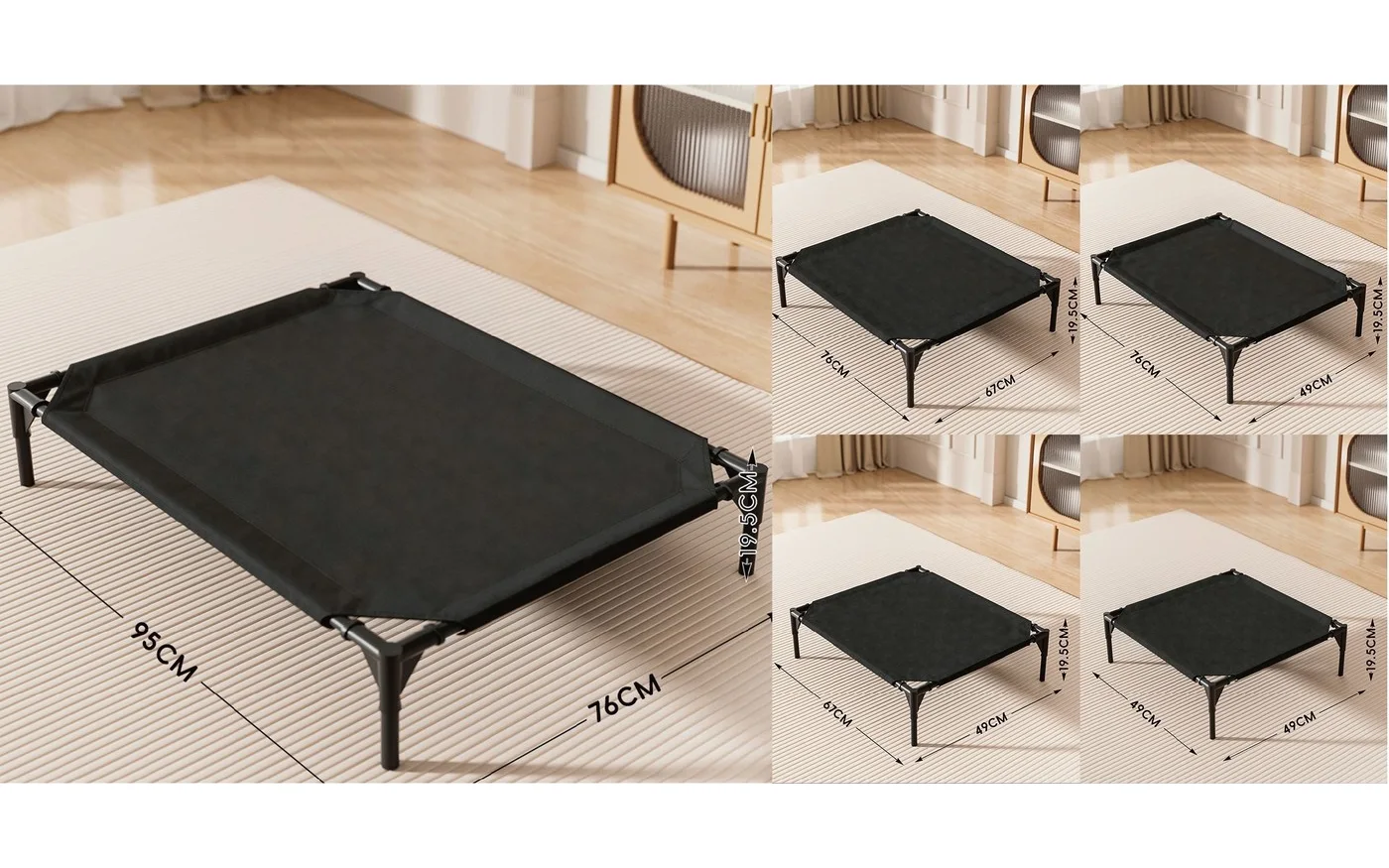
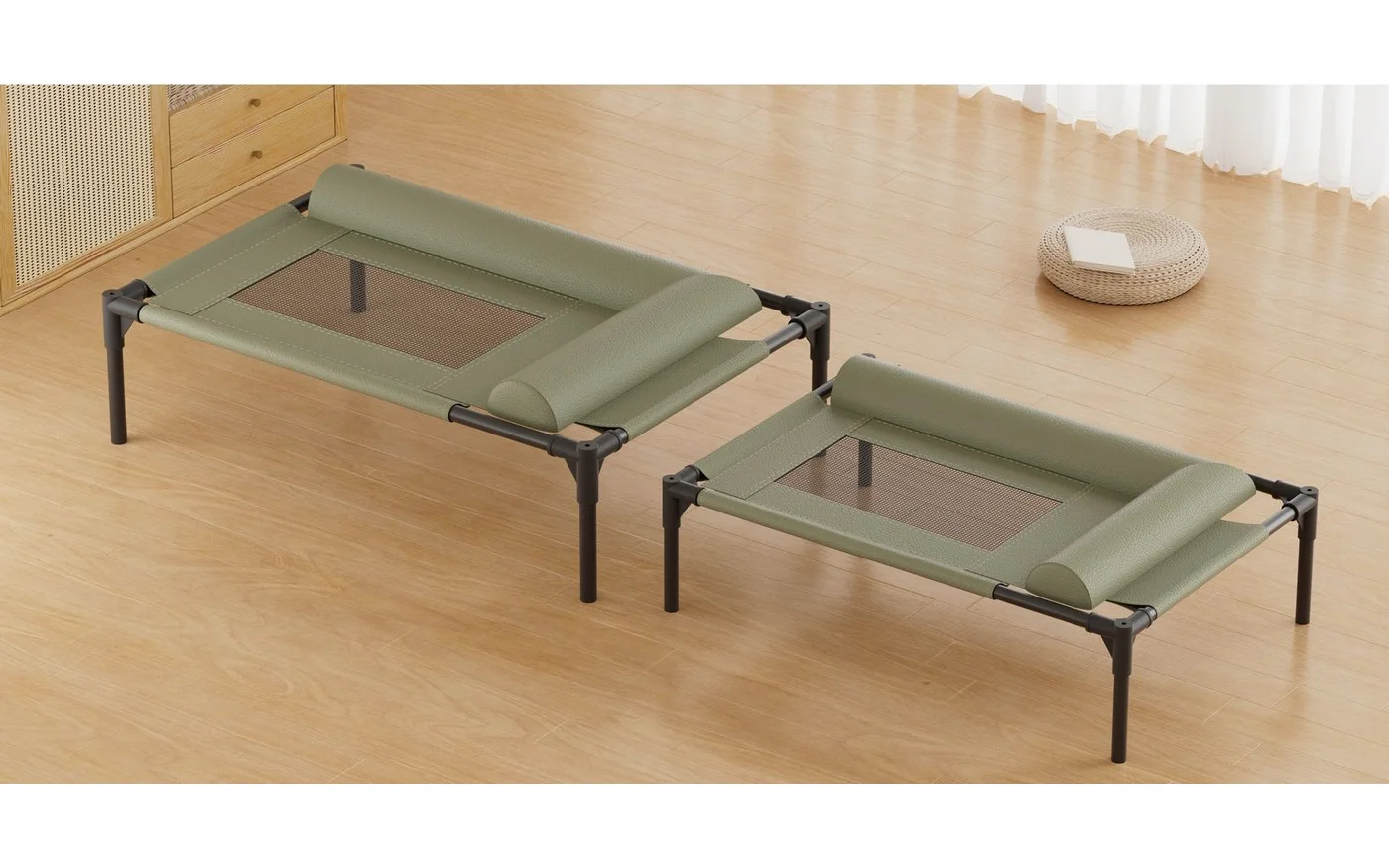
That's exactly why elevated cots — the ones with a breathable mesh stretched over a raised frame — work so well for hot dogs. Air circulates under the body instead of trapping heat, and the mesh doesn't hold warmth the way foam does. It's not a gimmick. It's a different category of product entirely, and for a heat-sensitive dog it's often the difference between a bed that gets used and one that becomes expensive floor decor.
The flip side matters too. If your dog burrows under blankets, wedges itself into corners, or shivers in cool weather, it's telling you it runs cold, and then a deep, soft, bolstered bed is genuinely the right call. There is no single "best" dog bed. There is only the bed that matches the dog's internal thermostat — and you already have the data to find it.
Size Charts Lie. Measure the Sleeping Shape Instead
Every dog bed comes with a size guide: "For dogs up to 25 pounds, choose medium." These charts are mostly fiction, and they lead people to buy beds that are two sizes too small.
The reason is that weight is a terrible predictor of how a dog occupies space. A 25-pound dachshund is a long, low tube. A 25-pound French bulldog is a compact brick. A 25-pound Border Collie is mostly leg. Three dogs, same weight, three completely different sleeping footprints. And most dogs don't sleep curled into a neat ball the way the product photo implies — they stretch, sprawl, roll onto their backs, and hang legs over the edge.
The right way to size a bed is to measure the dog in its favorite sleeping position, not standing up. Wait until your dog is fully asleep and stretched out the way it actually likes, then measure from the tip of the nose to the base of the tail (and add a few inches, because they always find a way to extend further). That number, not the weight chart, is the minimum length of the bed you should buy. If you can't get the dog to hold still, a rough rule is: a bed should let the dog lie fully flat with its head on the bed and its legs not dangling off. If the paws hang off, the bed is a lap blanket, not a bed, and the dog will eventually give up on it.
Support Is About Joints, Not Just Softness
There's a widespread belief that softer is always more comfortable for dogs, and it's wrong in a specific way that matters as dogs age. Very young, healthy dogs can sleep on almost anything. But a dog with arthritis, hip dysplasia, or just the general stiffness of middle age needs support — and "support" doesn't mean "pillowy."
A bed that's too soft lets the body sink in, which means the joints rest at awkward angles and the dog has to work to climb out of it every time it stands. That's why a heavy senior dog will sometimes abandon a plush bed for the floor: the floor is hard to lie down on, but it's stable to stand up from. The sweet spot is a bed that cushions the pressure points without letting the body sink — moderate density foam or a taut, supportive surface. Orthopedic marketing is real, but "orthopedic" is a promise, not a material spec. Ask what the bed is actually made of and how firm it is, because that's the part that affects your dog's hips at 3 a.m.
Placement Matters as Much as the Product
Even the perfect bed fails if it's in the wrong place, and this is the mistake that costs people the most, because it has nothing to do with spending.
Dogs are den animals with a strong preference for two things: being able to see what's going on, and being able to retreat from it. A bed shoved into a dark, unused corner of a hallway fails the first test. A bed placed in the exact center of a busy living room, in the flow of foot traffic and noise, fails the second. The winning spot is usually against a wall or in a corner with a sight line to the room — protected from behind, open to the front. Think of it as the difference between a booth in a restaurant and a table in the middle of the floor. Most dogs, like most people, want the booth.
Put the bed where your dog already likes to settle. If it keeps choosing the cool tile by the window, put the cot there. If it follows you into the office, put a bed in the office. A $40 bed in the right place will get used more than a $150 bed in the wrong one. That's not a compromise on quality — it's how you get the quality to actually matter.
What Actually Deserves Your Money
Strip away the marketing and the decision narrows to a few honest questions. Is the dog hot or cold? (That picks cot versus plush.) How does it actually sleep? (That picks size.) How old is it and how are its joints? (That picks support.) Where will the bed live? (That picks whether it gets used at all.)
And one more, because it's the part people forget until week three: how easy is this thing to clean? A dog bed is a sponge for hair, drool, dirt, and the occasional accident, and a bed that can't be cleaned becomes a health problem. A cot with a wipe-down mesh surface or a bed with a genuinely removable, machine-washable cover will outlast and out-hygiene the prettiest un-cleanable cushion every single time.
Buy for the body in front of you, not the one in the catalog photo. Your dog has been telling you exactly what it wants. It just does it with its feet instead of its voice.
Referenced in this guide

Keep reading